

The United Service Organizations (USO) has played a vital role in supporting American military personnel for over eight decades. Founded in 1941, just before the United States entered World War II, the USO quickly became a beacon of comfort and entertainment for service members. President Franklin Roosevelt’s vision of uniting civilian agencies to aid those in uniform gave birth to this nonprofit organization.
As America’s involvement in World War II grew, so did the USO’s reach and impact. The organization set up centers where troops could relax, socialize, and enjoy a taste of home. These havens offered simple pleasures like hot coffee, movies, and dances. The USO also brought star power to the troops, with celebrities performing at venues like New York’s Stage Door Canteen and the Hollywood Canteen. By 1944, USO Camp Shows were putting on an impressive 700 performances daily, bringing smiles to faces both at home and near the front lines.
Famous USO Performers
Bob Hope stood out as a top USO entertainer. He did about 60 tours over 50 years to perform for troops. His first show for soldiers was on a ship in 1939. He kept doing shows all through World War II. Hope often wore army clothes and carried a golf club when he performed.
Other big stars also did USO shows. Marilyn Monroe sang for soldiers in Korea in 1954. James Brown performed in Vietnam in 1968. Sammy Davis Jr. also went to Vietnam to entertain troops in 1972.
The USO has hosted many famous acts over the years:
- Robin Williams
- Toby Keith
- The Miz (WWE wrestler)
These performers boosted troop morale in war zones. Their shows gave soldiers a taste of home and a break from the stress of combat. The tradition of star-studded USO tours continues today, bringing entertainment to U.S. forces around the world.
The Singing Stars Who Lifted Wartime Spirits
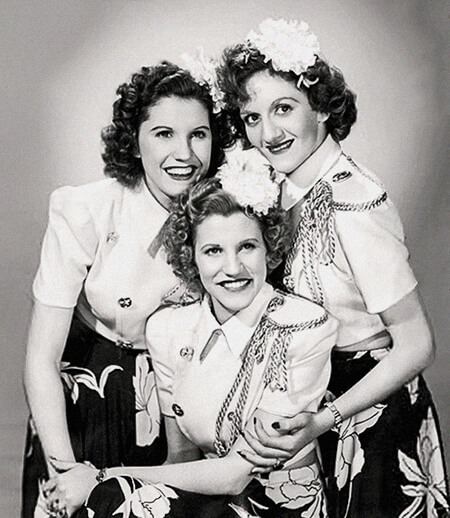
The Andrews Sisters became the voice of a generation during the 1940s. LaVerne, Maxene, and Patty Andrews brought joy to millions with their upbeat harmonies and catchy tunes. Their music defined the swing and boogie era, with songs like “Boogie Woogie Bugle Boy” becoming instant classics.
These talented sisters did more than just make hit records. They threw themselves into supporting the war effort. The Andrews Sisters:
- Performed countless shows for troops
- Helped start the Hollywood Canteen for service members
- Made special recordings just for allied forces
- Promoted war bonds through their music
Their tireless work earned them the nickname “Sweethearts of the Armed Forces Radio Service.” The sisters’ patriotic spirit and infectious energy lifted morale both at home and abroad during tough times.
Few artists matched their impact on 1940s popular culture. The Andrews Sisters left a lasting mark on music history and wartime entertainment.
“White Christmas” – A Wartime Classic

Bing Crosby’s rendition of “White Christmas” became a beloved holiday tune during World War II. The song, written by Irving Berlin, struck a chord with soldiers stationed far from home. Its lyrics paint a picture of a snowy Christmas scene, evoking memories of happier times.
Crosby first performed “White Christmas” in the 1942 film “Holiday Inn.” The song’s popularity soared, becoming Crosby’s biggest hit. Its nostalgic tone resonated deeply with troops overseas, who longed for familiar holiday traditions.
As America’s most admired celebrity at the time, Crosby used his fame to boost morale. He participated in USO tours, entertaining soldiers alongside fellow stars like Fred Astaire and Bob Hope. These performances brought a taste of home to troops serving in distant lands.
“White Christmas” remains a timeless classic, its simple yet powerful lyrics continuing to capture the essence of holiday nostalgia for generations.
A Pioneer of Military Entertainment
Al Jolson set the stage for USO performances. In early 1942, he became the first big star to entertain troops at a military base. Jolson put on up to four shows daily, singing hits like “Sonny Boy” and “Mammy” for soldiers in various settings. His performances took place in foxholes, dugouts, and on bases.
Jolson’s dedication to boosting troop morale went beyond live shows. He created patriotic albums and films to support the war effort. His commitment came at a personal cost, though. While performing overseas, Jolson caught malaria and lost a lung. These health issues eventually led to his death in 1950.
The singer’s efforts paved the way for future USO tours and showcased the power of entertainment in lifting soldiers’ spirits during wartime.
“Every Woman Wears a Halo”

Female stars played a key role in USO shows during World War II. These tours let them see the world while supporting their country. Troops loved seeing famous women perform. The Andrews Sisters, Judy Garland, and Rita Hayworth traveled far to entertain soldiers. Their shows were fun for all ages and lifted spirits.
Lena Horne even visited the Tuskegee Airmen. These brave Black pilots faced racism at home while fighting for freedom abroad. Horne’s support meant a lot to them. Their hard work brought joy to troops facing tough times.