

When considering the most famous WWII plane, strong contenders include the Supermarine Spitfire, lauded for its agility and pivotal role in the Battle of Britain, and the P-51 Mustang, known for its long-range capabilities and essential contributions to Allied victories. Additionally, the often-overlooked Hawker Hurricane played a vital role, while the German Messerschmitt Bf 109 and Junkers Ju 87 were formidable adversaries. Each aircraft has its unique story and impact. But which one truly stands out as the most iconic? Let’s examine the defining features and historical significance of these legendary planes.
Supermarine Spitfire
Entering service with No. 19 Squadron in August 1938, the Supermarine Spitfire quickly became an iconic symbol of British defiance during WWII. Designed by Reginald Mitchell, the Spitfire featured an advanced all-metal airframe that highlighted its speed and agility. These characteristics made it a formidable RAF fighter, often likened to a greyhound for its sleek and nimble performance.
During the Battle of Britain, the Spitfire played a critical role in intercepting enemy aircraft, particularly German fighters. While the Hawker Hurricane focused on engaging bombers, the Spitfire was tasked with taking on the enemy’s more agile aircraft. This strategic division of labor allowed the RAF to effectively counter the Luftwaffe’s advances. The Spitfire’s contribution was significant, with 529 enemy aircraft shot down throughout the battle. However, this came at a cost, with 230 Spitfires lost in combat.
Despite not being the RAF’s most successful fighter regarding total kills—that honor goes to the Hawker Hurricane—the Supermarine Spitfire remains an enduring symbol of British resilience and aerial superiority. Its legacy is immortalized in the annals of history as a guiding light of hope during one of Britain’s darkest hours.
Hawker Hurricane

While the Spitfire often grabs the spotlight, the Hawker Hurricane’s substantial contributions during WWII are equally significant. As the most numerous aircraft in the RAF Fighter Command during the Battle of Britain, the Hurricane equipped 33 squadrons by September 1940. This remarkable machine achieved an impressive 656 enemy aircraft kills, making it the most successful fighter aircraft of the campaign.
The Hurricane’s traditional wood and metal design contributed to its stability and ruggedness. This construction made it easier to maintain compared to the Spitfire, which was essential during intense periods of conflict. Known affectionately as “the bulldog” for its toughness and reliability, the Hurricane proved irreplaceable in defending Britain.
Primarily deployed against German bombers, the Hurricane also engaged in dogfights with enemy fighters. This adaptability showcased the aircraft’s capability in diverse combat scenarios. Its reliability and ease of maintenance allowed for quick repairs and redeployment, keeping the RAF Fighter Command agile and effective.
During WWII, the Hawker Hurricane played a key role, not just as a fighter but as a symbol of resilience and strength. Its substantial contributions and impressive kill tally firmly place it among the most famous WWII planes.
P-51 Mustang
Renowned for revolutionizing air combat, the P-51 Mustang emerged as a high-performance fighter crucial during World War II. This aircraft, equipped with the powerful Merlin engine, significantly shifted the balance of air supremacy. The P-51 Mustang could reach a maximum speed of 437 mph and had a range of 1,000 miles, making it ideal for escorting bomber formations. By the summer of 1944, it drastically reduced bomber loss rates, proving its effectiveness.
The P-51D model’s firepower was formidable, featuring six .50 caliber machine guns capable of destroying enemy aircraft. The Mustang’s arrival in the European theater was a game-changer for Allied air operations, especially during significant campaigns like the Normandy invasion in 1944. The 332nd Fighter Group, famously known as the Red Tails, demonstrated the plane’s effectiveness by flying over 15,000 sorties with just 66 losses.
Key statistics:
| Feature | Specification | Impact |
|---|---|---|
| Max Speed | 437 mph | Fast response capabilities |
| Range | 1,000 miles | Extended escort missions |
| Armament | Six .50 caliber guns | Superior firepower |
| Red Tails Sorties | 15,000+ (66 losses) | Effectiveness in combat |
The P-51 Mustang’s contributions were undeniable, solidifying its place as a legend in aviation history.
Messerschmitt Bf 109
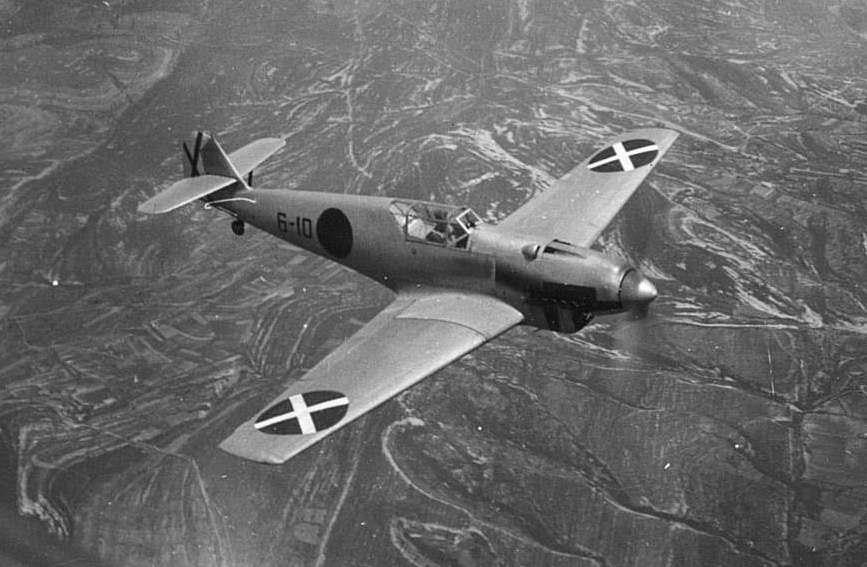
As the P-51 Mustang soared to prominence, its German counterpart, the Messerschmitt Bf 109, played a vital role in the skies of Europe. Known as one of the best fighters in the world in 1940, the Bf 109’s performance was unmatched, especially at high altitudes. Its speed and agility made it a formidable opponent.
Armed with two cannons and two machine guns, the Messerschmitt Bf 109 was deadly in the hands of experienced Luftwaffe pilots. These pilots utilized the aircraft’s strengths, executing ambush tactics to enhance its effectiveness. Despite its prowess, the Bf 109 had a limited operational range, which sometimes restricted its strategic deployment.
The Bf 109 saw heavy losses, particularly during the Battle of Britain, where around 650 units were lost. However, it remained a critical component of the Luftwaffe’s air fleet, with approximately 33,000 units built across different versions throughout the war. As a result, the Messerschmitt Bf 109 became the most produced fighter aircraft of WWII. Its legacy reflects its significant impact and the skill of the pilots who flew it.
Junkers Ju 87

The Junkers Ju 87, or Stuka, is a notable aircraft in WWII aviation history for its precision bombing, especially during the early blitzkrieg campaigns. Known for its near-vertical dives, the Ju 87 could hit targets with remarkable accuracy, effectively supporting ground troops by dismantling enemy positions and infrastructure to facilitate rapid advances.
However, its early success faced significant challenges. On August 18, 1940, during the Battle of Britain, the Ju 87 encountered intense aerial opposition, resulting in the loss of 12 aircraft in a single day. This event marked a pivotal point in its operational history.
The Ju 87’s design featured distinctive inverted gull wings, enhancing its stability and dive-bombing performance. These wings became a recognizable hallmark of the Stuka’s silhouette.
As the war progressed, increasing Allied aerial superiority and high casualty rates led to the gradual withdrawal of the Ju 87 from frontline operations. The introduction of more advanced Allied fighters diminished the Stuka’s effectiveness, ultimately leading to its decline as a dominant force in WWII aviation.