

Imagine Europe poised on the brink of a storm. The Phoney War was this eerie calm from September 1939 to May 1940 after Britain and France declared war on Germany. You’d think more battles happened, but most action centered on defensive strategies and a naval blockade. It was a time of rationing and blackouts for civilians. Then, Germany’s Blitzkrieg radically changed the scene. There’s so much more to unfold in this complex chapter.
The Onset of the Phoney War
Although World War II officially began with Germany’s invasion of Poland, the onset of the Phoney War marked a peculiar lull in the conflict. On September 3, 1939, the British government and France declared war on Germany. Yet, despite this declaration, minimal military engagement occurred on the Western Front.
The French Army’s brief foray into Germany’s Saar district was quickly halted. While German invasions in Poland were swift and brutal, the Western allies focused more on defensive maneuvers, such as building a naval blockade to weaken Germany. Despite the inactivity on the Western Front, the Royal Air Force was being revitalized and expanded in preparation for the impending conflict.
During this time, the Phoney War saw little direct confrontation, as the Allies prepared for future battles. This period of inactivity persisted until the aggressive German invasions in spring 1940 reignited active conflict.
Strategic Developments and Military Stalemate
The Phoney War’s lull in direct military engagement gave way to a period of strategic contemplation and preparation.
In Western Europe, the French government and the British Expeditionary Force focused on defensive strategies, resulting in a military stalemate. They aimed to weaken Nazi Germany with a naval blockade and limited actions like isolated bombing raids.
The French attempted the Saar Offensive on September 7, 1939, briefly advancing into Germany but quickly pulling back, showing their indecisiveness. Meanwhile, Germany’s forces also held back, marking time until their planned assault.
Naval engagements were costly for Britain, as evidenced by the loss of HMS Courageous and HMS Royal Oak. The stalemate ended when Germany invaded Norway, then France, Belgium, and the Netherlands in May 1940. During this period, the Battle of Britain was a crucial air conflict that demonstrated the importance of air superiority for both sides.
Civilian Life and Wartime Policies
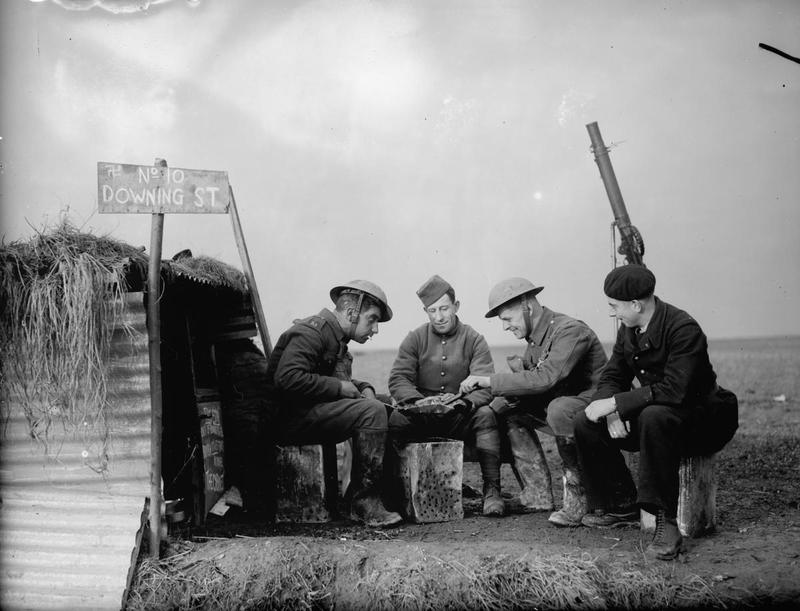
As the Phoney War unfolded, civilians in Britain felt the weight of wartime policies directly impacting their daily lives. Strict rationing, limiting access to food, fuel, and clothing were experienced. Blackout regulations made nighttime dangerous, with accidents and even fatalities as everyone adjusted.
The government’s evacuation policies separated families, moving 6 million women and children to safety from potential bombing raids. Hospitals emptied in anticipation of casualties, showcasing the government’s preparedness for civilian injuries. The initial British civilian casualty during a March 1940 bombing raid heightened your concerns about safety.
Wartime policies dominated everyone’s life, requiring constant vigilance and adaptation, as the government sought to balance civilian safety with readiness for the escalating conflict around.
Prelude to Escalation: Key Incidents and Turning Points
With wartime policies altering daily life, the tension building towards more active conflict was sensed. The Phoney War period featured minimal military action despite Britain and France declaring war after Germany’s invasion of Poland.
As events unfolded, key incidents signaled impending escalation:
- The Saar Offensive launched by the French on September 7, 1939, quickly stalled.
- The British Expeditionary Force was present but engaged in limited operations.
- Aerial conflict began with the Luftwaffe targeting British naval forces.
- Germany’s Blitzkrieg shattered the quiet with its invasion of Denmark and Norway on April 9, 1940.
These events marked a change from the quiet Phoney War to intense conflict in Western Europe, culminating in the Dunkirk evacuation and a broader naval blockade of Germany.
The Shift in British Political Leadership
While the Phoney War lulled Europe into a deceptive calm, British political leadership faced a seismic shift as Neville Chamberlain resigned on May 10, 1940.
Criticized for his handling of the failed Norwegian campaign and inability to form a national government, Chamberlain succumbed to pressure following a heated House of Commons debate.
The German invasion of Norway highlighted the need for stronger leadership during this vital period of World War II.
Enter Winston Churchill, appointed Prime Minister the same day. His leadership marked a turning point, emphasizing a more aggressive military stance against Nazi Germany.
Churchill’s ability to rally public support and unite a coalition government of Conservatives, Labour, and Liberals was essential in fortifying Britain’s resolve against the mounting threat.