

The IS-2 was a Soviet heavy breakthrough tank introduced in late WWII to counter German tanks like the Tiger I. Armed with a powerful D-25T 122mm gun, it pierced enemy armor effectively. Its robust 100mm thick angled armor offered strong defense. The IS-2 markedly impacted operations, aiding Soviet advances with low casualties. After WWII, its design influenced future armored vehicles. There’s much more to uncover about its impressive legacy.
Image: Cmapm, IS-2 Model 1943 – Sevastopol, CC BY-SA 4.0
Development and Design Evolution
Although the Soviet Union faced the formidable challenge of countering German tanks like the Tiger I and Panther, they quickly responded with the development of the IS-2 heavy tank.
As a Soviet heavy tank, the IS-2’s design evolution began with the Object 237 prototype. Initial ideas led to the choice of the potent D-25T 122mm gun, enhancing its capacity against German armor. Production commenced in December 1943, resulting in 3,854 units by the war’s end.
The IS-2’s hull armor, with a front thickness of 100mm at a 60° angle, and turret armor, also 100mm, provided robust protection. Design iterations, like the IS-2 Model 1944, improved its combat effectiveness, securing its place as a formidable force on the battlefield.
Armament and Firepower Capabilities

Equipped with the formidable D-25T 122 mm gun, the IS-2 heavy tank delivers impressive firepower capable of piercing enemy armor at distances up to 2,500 meters.
This Soviet heavy tank’s main armament outmatches earlier designs like the F-34 76.2 mm gun, offering superior armor penetration.
Carrying 28 rounds, including 20 high-explosive (HE) and 8 armor-piercing (AP) rounds, the IS-2 adapts easily to diverse combat scenarios. Initially, its rate of fire was 1 to 1.5 rounds per minute, but improvements later elevated it to 2-3 rounds, increasing battlefield capabilities.
Secondary armament features 1× DShK and 3× DT machine guns, with 2,079 rounds for anti-infantry roles. The 122 mm HE shells effectively neutralize enemy positions without direct armor penetration.
Armor and Defensive Features
While the IS-2’s firepower made it a formidable opponent on the battlefield, its armor and defensive features were likewise impressive.
The hull’s front armor boasted a 100mm thickness at a 60° angle, optimizing defensive protection against enemy fire. At the front, the turret also featured 100mm of rounded armor, with an extra 120mm mantlet, ensuring robust protection for the main gun.
Side armor ranged from 90 to 130mm, providing a strong defense against German anti-tank weapons like the 88mm gun. The armor was primarily cast, allowing for complex shapes, although it sometimes had inconsistent quality.
Operational Impact and Combat Performance
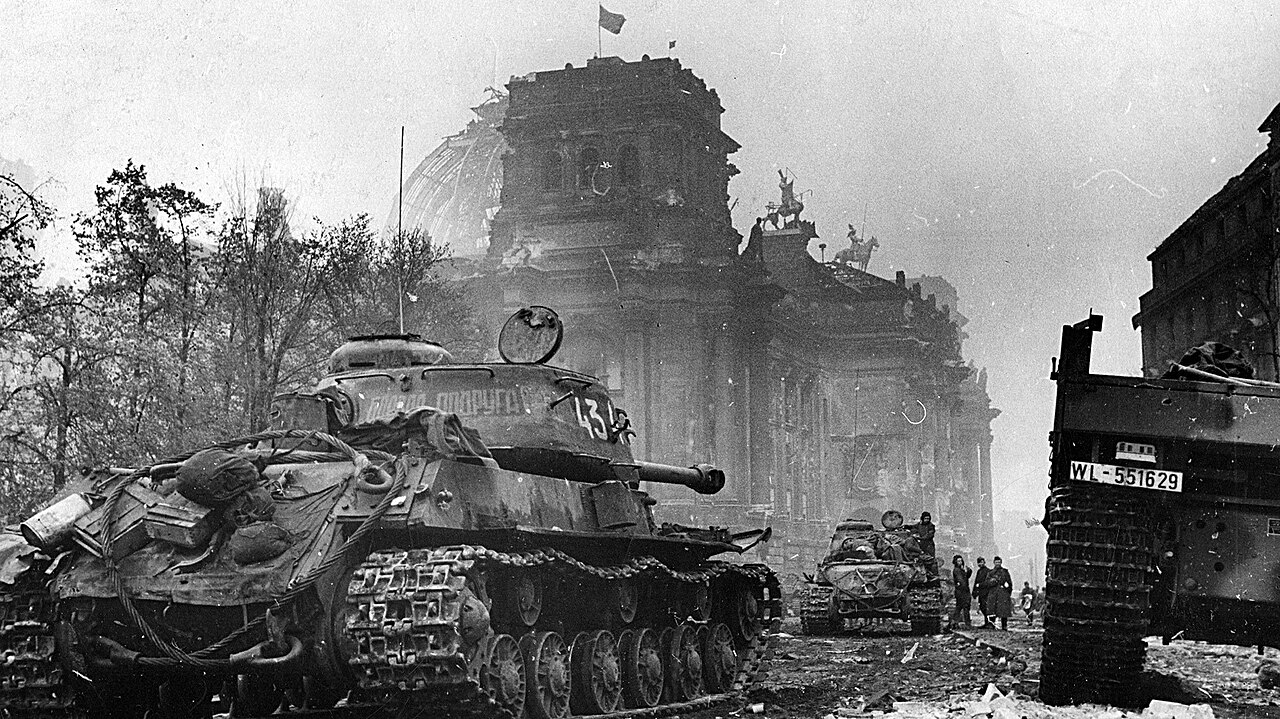
As the IS-2 initially rolled onto the battlefield in early 1944, its presence was nothing short of transformative. This heavy tank, armed with the formidable D-25T gun, reshaped the dynamics of combat against German tanks like the Tiger I and Panther.
The IS-2’s thick armor provided the protection needed to withstand the powerful 88 mm guns, making it a key player in armored warfare. Its ability to destroy over 40 German tanks and fortifications during major offensives, including the Battle of Berlin, cemented its role as a breakthrough tank in Soviet military strategy.
With a regiment of 21 tanks, the IS-2 proved its worth by delivering effective firepower, securing Soviet advances, and sustaining low casualties throughout the conflict.
Legacy and Post-War Influence
Though the battlefield has long since quieted, the legacy of the IS-2 echoes in the annals of military history. This Soviet heavy tank showcased remarkable durability and armor protection, serving countries like Cuba, China, and North Korea beyond World War II.
Despite its combat performance, the IS-2 became obsolete by the 1950s with the rise of main battle tanks, leading to its retirement by the late 1960s. However, its design set a benchmark for future armored vehicles, influencing post-war developments.
The historical significance of the IS-2 is preserved in museums worldwide, from the Imperial War Museum to Beijing’s Tank Museum. Military historians like Steven Zaloga and James Grandsen have documented its impact, shaping modern tank warfare strategies.