

The Battle of Wuhan in 1938 was a fierce test of China’s resilience during the Second Sino-Japanese War. It was a protracted conflict where strategic control of this crucial transportation hub was critical. The National Revolutionary Army faced immense challenges, from resource shortages to humanitarian crises exacerbated by flooding. Despite Japanese aggression and chemical warfare, Chinese forces and civilians demonstrated remarkable tenacity and unity. You’ll uncover more about the siege’s significant impact and eventual global implications.
The Strategic Importance of Wuhan
Wuhan’s strategic importance during the Second Sino-Japanese War can’t be overstated. As the de facto wartime capital, it was a crucial command center for the National Revolutionary Army.
Its strategic location as a major transportation hub, especially due to the Yuehan Railway, made it essential for the Chinese war effort. The city’s divisions—Wuchang as the political center, Hankou as the commercial district, and Hanyang as the industrial area—each played significant roles in sustaining operations against Japanese forces.
Capturing Wuhan was crucial for Japan, aiming to cripple Chinese logistics and morale. The Battle of Wuhan demonstrated its significance, with Japan suffering heavy losses, underscoring Wuhan’s role as a focal point in China’s resistance efforts.
Prelude to the Battle

As the Second Sino-Japanese War raged on, preparations for the Battle of Wuhan intensified. The Military Affairs Commission played a vital role in strategizing the defense of Wuhan, redeploying 1.1 million National Revolutionary Army troops after Xuzhou’s fall.
You’d witness how the National Mobilization Law passed on March 24, 1938, enabled unlimited war funding and civilian conscription, underscoring the importance of preparation.
- On February 18, 1938, Chinese forces repelled a Japanese air strike, marking the start of intensified military actions.
- Major Japanese air strikes on April 29, 1938, escalated tensions further.
- Anticipating invasion, the Chinese opened the dikes of the Yellow River on June 9, causing the 1938 Yellow River flood.
Each action shaped the defense of Wuhan and civilian resilience.
Defensive Preparations and Military Strategies
Despite the looming threat, the Chinese Military Affairs Commission methodically orchestrated the defense of Wuhan, focusing their strategies around natural barriers like the Dabie Mountains, Poyang Lake, and the Yangtze River.
You’d find their defensive preparations impressive as they redeployed 1.1 million National Revolutionary Army troops. These strategic locations served as fortifications against Japanese advances. Key commanders, Li Zongren and Bai Chongxi, led these military strategies, emphasizing resistance.
The successful repulsion of a Japanese air strike on February 18, 1938, marked the start of ongoing military actions. The National Mobilization Law passed in March allowed conscription, ensuring an influx of manpower.
At critical points like Madang, major fortifications bolstered defenses, showcasing China’s commitment to protecting Wuhan.
Key Engagements and Battles
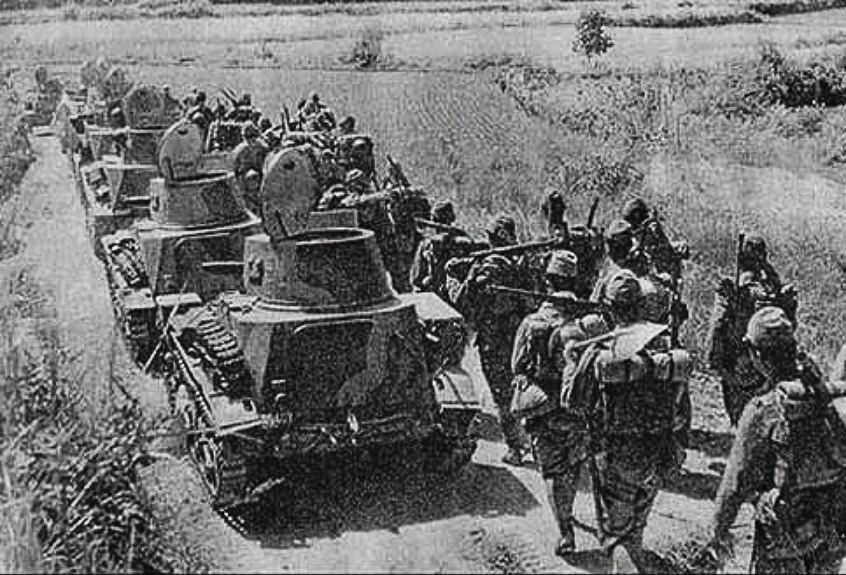
Although the Battle of Wuhan erupted on June 15, 1938, with the Japanese capture of Anqing, it was a series of fierce engagements along the Yangtze River that truly defined the conflict.
You’d witness the determination of Chinese defenders and the tactical strategy of the Japanese Army in these military engagements:
- The Battle of Wanjialing on October 7, 1938, where Chinese forces celebrated a significant victory and decimated four Japanese regiments.
- The Japanese employed poison gas during the Battle of Tianjiazhen, starting August 30, 1938, violating international laws.
- A prolonged siege at Tianjia Town Fort, showcasing Japanese military prowess.
- The southern advance, seizing Ruichang on August 24.
- Tremendous casualties on both sides, totaling an estimated one million.
These engagements underscored the brutal and resilient nature of the conflict.
The Role of Air Warfare
The Battle of Wuhan prominently featured air warfare, with Japanese forces launching aggressive air strikes that intensified the conflict. On April 29, 1938, the Japanese air force celebrated Emperor Shōwa’s birthday with a significant attack, showcasing their air superiority.
Despite early successes like the 2.18 Air Battle, where Chinese air defenses repelled a Japanese assault, China’s lack of adequate aircraft and resources hampered their air combat effectiveness. This deficiency limited their ability to launch successful counter-offensives against strategic bombings targeting military positions and urban areas.
The Japanese also controversially used poison gas, violating international agreements and underscoring the brutal nature of their tactics. These air warfare strategies played a critical role in Japan’s campaign during the lengthy siege.
Guerrilla Tactics and Resistance Efforts
Throughout the Battle of Wuhan, Chinese forces strategically employed guerrilla tactics to combat the Japanese, especially north of the Yangtze River. You’d find these efforts crucial in disrupting Japanese supply lines and enhancing morale.
The National Revolutionary Army engaged in:
- Targeting spies and traitors: Operations led by Dai Li focused on disrupting enemy networks.
- Fortifying positions: At Tianjiazhen, Chinese troops held a prolonged siege with massive battlements.
- Executing counter-offensives: They cleverly used local terrain to recapture strategic locations like Taihu and Susong.
- Sabotage tactics: These targeted Japanese supply routes and communications, weakening enemy operations.
- Enhancing morale: Despite overwhelming odds, their resilience underscored the strength of the resistance efforts.
These actions highlighted their determination during the prolonged siege.
The Use of Chemical Weapons
During the Battle of Wuhan, Japanese forces released a devastating campaign of chemical warfare, authorized by Emperor Shōwa.
The Japanese Army’s use of chemical weapons, including poison gas, flagrantly violated international agreements like the 1899 Hague Declaration and the 1907 Hague Convention. These brutal wartime practices led to significant casualties among Chinese troops and civilians, sparking international condemnation.
On May 14, 1938, the League of Nations denounced Japan’s actions, emphasizing the global outcry. The deployment of poison gas at battles such as Tianjiazhen exemplified the terror inflicted by these tactics.
Beyond the immediate physical harm, the psychological toll on the Chinese populace was immense, deepening the conflict’s impact and leaving lasting scars on those affected by this terrifying warfare.
Humanitarian Impact and Civilian Struggles
While the horrors of chemical warfare cast a dark shadow over the Battle of Wuhan, the broader humanitarian impact left an indelible mark on civilian life.
You faced a severe humanitarian crisis, where civilian struggles were relentless. The displacement of about 1.5 million people turned into a dire refugee crisis. Atrocities like mass executions and sexual violence inflicted unimaginable suffering. The deliberate 1938 Yellow River flood worsened the situation, its environmental impact destroying homes and farmland.
- Displacement: Thousands fled, seeking safety from violence.
- Refugee Crisis: Overwhelmed resources led to inadequate shelter and aid.
- Food Shortages: Scarcity left many starving.
- Lack of Medical Care: Illnesses went untreated, worsening conditions.
- Propaganda Efforts: Both sides distorted reality, adding to confusion.
Long-term Implications and Historical Significance
Though the Battle of Wuhan ended in a strategic victory for Japan, its long-term implications reshaped the conflict and left a lasting historical significance.
The immense casualties, with up to one million military and civilian losses, highlighted the severe toll on both sides. Despite Wuhan’s capture, the Chinese Army’s ability to inflict heavy casualties on Japanese forces showcased their resilience.
This crucial battle shifted the focus from large-scale confrontations to guerilla warfare and localized resistance. The Chinese strategically preserved their strength, adapting to territorial losses without surrendering their fighting spirit.
Meanwhile, Japan’s overextension and lack of clear objectives prolonged the war, leading to a drawn-out conflict that extended until the end of World War II, underscoring its historical significance.