

In the Battle of Narvik, Norway’s crucial location and resources made it a key WWII battleground. You’d uncover how German naval forces initially surprised and secured Narvik, capitalizing on Swedish iron ore routes. Despite Norway’s swift surrender, their resistance continued, prompting fierce British counterattacks. Both sides grappled with challenging terrain and supply issues, impacting naval and land operations considerably. Exploring further reveals the lasting legacy and strategic shifts that emerged from this crucial clash.
Image: Ukjent/Unknown, Allied soldiers during the battle of Narvik, CC BY-SA 2.0
Strategic Importance of Norway in WWII
Although often overshadowed by more famous battles, the strategic importance of Norway in WWII can’t be overstated. You see, Norway’s location was critical for controlling shipping lanes in the North Sea. Narvik, a Norwegian port, played a significant role due to its ice-free conditions and was a key transshipment point for Swedish iron ore shipments necessary to Germany’s war effort.
The German invasion, known as Operation Weserübung, aimed to secure this area and prevent the Allies, particularly British forces, from establishing a blockade similar to WWI. Control of Narvik wasn’t just about land dominance; it was central to naval battles. Securing Norwegian ports allowed the Germans to improve their maritime operations, making Norway a fundamental battleground for both sides.
German Naval Tactics and Initial Successes
As the German Navy launched its operations in the Battle of Narvik, their swift and decisive tactics led to early triumphs. Under Commodore Friedrich Bonte, German forces utilized ten destroyers to execute surprise landings at Ofotfjord, catching the Norwegian coastal defense unprepared.
This maneuver allowed them to capture Narvik without firing a shot and seize a vital military depot along with five armed British merchant ships.
During initial naval engagements, these German naval tactics proved effective, sinking the Norwegian monitor Eidsvold and damaging British destroyers. However, despite these initial successes, they faced significant supply challenges. Reliance on airdrops and seaplane landings became essential as British naval actions depleted the German destroyer force, ultimately straining their operational capabilities.
Norwegian Resistance and Surrender of Narvik
While Norwegian forces were caught off guard by the German assault, Colonel Konrad Sundlo found himself unprepared to defend Narvik effectively. On April 10, 1940, he negotiated a surrender to General Eduard Dietl’s German forces without engaging in battle.
The Germans quickly seized Narvik, capturing around 500 Norwegian soldiers and a significant military depot. Poor intelligence regarding Norwegian coastal defenses, including the sinking of the monitor Eidsvold, accelerated the German takeover.
Despite this setback, Norwegian forces continued their resistance in the surrounding areas, complicating German supply lines and operations. The surrender marked a turning point in the region, underscoring the challenges the Allied forces faced in their efforts to reclaim Narvik from German occupation.
British Naval Response and Tactical Decisions
The German occupation of Narvik presented an immediate challenge to the Allies, prompting a swift response from British naval forces. Led by Captain Bernard Warburton-Lee, the British naval forces launched a series of counterattacks to regain control of the strategic port.
In the initial naval battle on April 10, 1940, they successfully sank the German flagship Wilhelm Heidkamp. Despite these successes, the British faced challenges during their withdrawal, as German destroyers attacked, resulting in the loss of HMS Hunter and the damage of HMS Hardy.
The Royal Air Force, revitalized in response to the threat from Nazi Germany, provided crucial air support during the conflict. However, the Royal Navy’s return on April 13 marked a decisive victory, eliminating the German destroyer flotilla. Tactical decisions, such as planning amphibious landings, demonstrated adaptability in this critical conflict.
First Naval Battle of Narvik
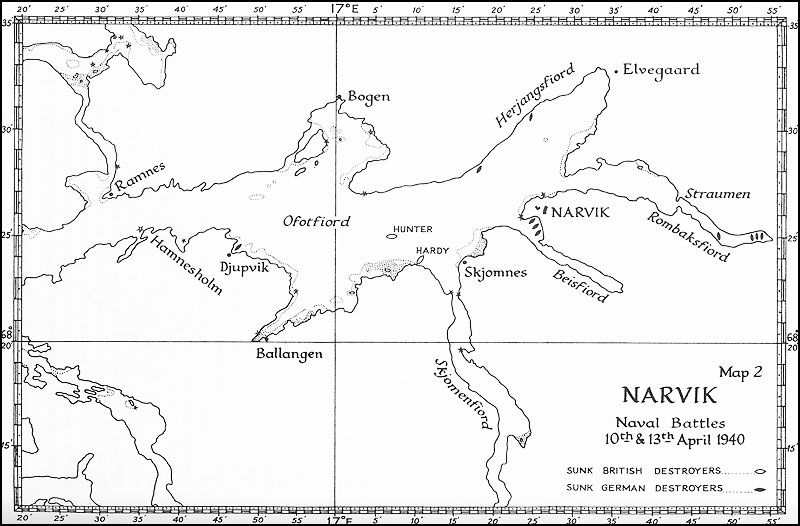
April 10, 1940, marked a bold move by the British as they launched a surprise attack on the German fleet in Narvik harbor. This engagement, known as the initial naval battle of Narvik, saw British destroyers, led by Captain Bernard Warburton-Lee, striking decisively. Within an hour, they sank the German flagship Wilhelm Heidkamp and disabled 14 merchant ships.
This victory underscored Narvik’s strategic importance, particularly for German supply lines reliant on iron ore shipments from Sweden during WWII. The battle highlighted the broader significance of aerial operations in WWII, as seen in the USAAF’s contributions to the Allied victory through strategic bombing and air support campaigns.
However, as the British withdrew, German destroyers emerged, sinking HMS Hunter and immobilizing HMS Hardy. The battle set the stage for further naval engagements, reflecting the fierce competition for control in this critical region.
German Counterattack Strategies
During the Battle of Narvik, German counterattack strategies were essential in their efforts to regain control after the initial British assault. You can see how they relied heavily on their naval forces, particularly destroyers, to challenge the British fleet. Their actions led to the sinking of the British destroyer Hunter and the immobilization of the flagship Hardy.
German forces also included sailors from these destroyers in their ground units, maintaining pressure on Allied forces despite logistical challenges. Securing Narvik and its critical supply routes for iron ore was their strategic goal. However, mechanical issues and fuel shortages hampered their efforts. Although they initially succeeded, these challenges eventually led to a stalemate with the Allied forces until mid-May 1940.
Challenges in Supply and Terrain for Both Sides
Although the Battle of Narvik presented strategic opportunities, both German and Allied forces grappled with severe supply challenges due to Norway’s unforgiving terrain and harsh weather.
The rugged terrain and logistical complications made resupply efforts a nightmare. German troops depended on unreliable airdrops and seaplane landings, as their initial landings left them with scant resources. The Bardufoss airfield’s non-serviceability further hindered their operations.
Meanwhile, Allied forces struggled with coordinating supply chains, creating confusion and reducing effectiveness. The Arctic terrain, with its steep mountains and fjords, heavily influenced tactical movements, leading to a prolonged stalemate.
- Supply challenges plagued both forces.
- Rugged terrain complicated logistics.
- Harsh weather affected resupply efforts.
- Tactical movements were severely restricted.
- Prolonged stalemate frustrated both sides.
Allied Amphibious Operations
As the Battle of Narvik unfolded, Allied forces launched ambitious amphibious operations to seize control of the strategic port from the Germans. British and French troops, led by General Claude Auchinleck, made significant landings on May 12, 1940.
These operations aimed to recapture Narvik, facing stiff German resistance and harsh Arctic conditions. Despite logistical challenges, like equipment confusion and divided command, the Allies’ numerical superiority played a vital role.
These operations were early examples of coordinated joint operations between naval and ground forces, marking tactical successes. They improved supply lines and regained essential positions.
However, despite their efforts, the larger military situation in France overshadowed these successes, leading to eventual withdrawal. Still, valuable lessons were learned for future engagements.
Withdrawal and Broader Geopolitical Shifts
Faced with the rapid German advance into France, the Allies made the tough decision to withdraw from Narvik on June 8, 1940. This strategic decision, prompted by escalating tensions and the need to refocus efforts, highlighted the fragility of Allied positions in Northern Europe.
The withdrawal allowed German forces to consolidate control over Norway, securing essential iron ore shipments crucial for their war effort. This shift marked a significant moment in WWII, pushing the Allies to reevaluate their military presence and strategies amidst Germany’s successes in Western Europe.
As the situation evolved, the events in Narvik contributed to broader geopolitical shifts, underscoring the dynamic nature of the conflict.
- Allied withdrawal on June 8, 1940
- German consolidation in Norway
- Iron ore’s strategic importance
- Fragility of Allied positions
- Broader geopolitical shifts in WWII
Legacy of the Battle of Narvik in WWII History
The Allied withdrawal from Narvik on June 8, 1940, may have marked a turning point in the broader narrative of WWII, but the battle itself left an enduring legacy in the annals of military history.
The Battle of Narvik was a significant moment during the German invasion of Norway, showcasing the strategic importance of Norwegian waters. Despite initial successes, the German naval forces faced substantial losses against the Allied forces, particularly the Royal Navy, highlighting vulnerabilities in Operation Weserübung.
This naval battle underscored the courage and resilience of the Allies, who inflicted one of Hitler’s early defeats.
Today, the legacy of Narvik is honored through museums and memorials, reminding you of the bravery and cooperation that defined this vital chapter in WWII history.