

The Allied invasion of Sicily catalyzed Italy’s liberation during WWII, kicking off on July 10, 1943. Your expedition through Operation Husky highlights strategic goals like disrupting Axis supply lines and using deception to mislead German forces. Employing over 150,000 Allied troops, the landing was marked by strong coordination, though leaders like Eisenhower navigated complex dynamics. This operation set the stage for significant political shifts in Italy, promising more insights into critical moments.
Strategic Objectives and Planning
While the world was embroiled in conflict, the Allied powers carefully planned the invasion of Sicily, known as Operation Husky, marking an essential step in the Mediterranean campaign.
The mission focused on capturing key airfields and ports to facilitate future Allied operations in Italy. By targeting these strategic locations, the Allies aimed to disrupt Axis supply lines and weaken their Mediterranean stronghold.
Challenges were faced with commanders occupied in Tunisia, prompting Eisenhower to opt for dispersed landings. This strategy allowed simultaneous attacks on multiple fronts. Deception operations, particularly Operation Mincemeat, played a significant role by misleading German intelligence and diverting Axis forces away from Sicily.
The operation commenced on July 10, 1943, with a massive amphibious assault, setting the stage for Italy’s liberation. The effective coordination of Allied air forces, such as the RAF and the Army Air Forces, was crucial in achieving air superiority and supporting ground operations during the invasion.
Composition of Allied and Axis Forces
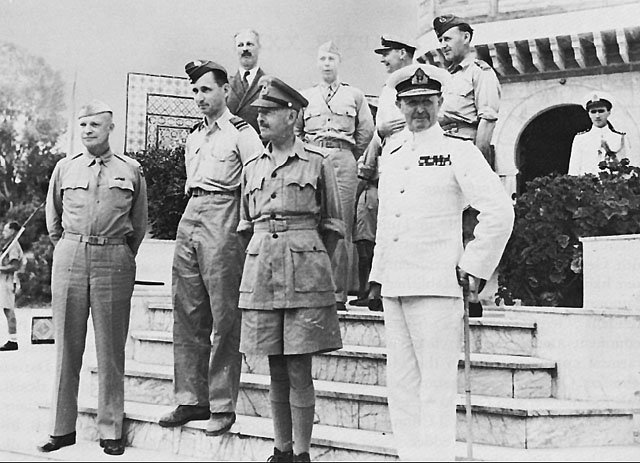
With strategic objectives set, the focus now shifts to the formidable composition of the Allied and Axis forces during the Sicily invasion.
There were over 150,000 troops from the U.S. Seventh Army and British Eighth Army. The U.S. Seventh Army included three infantry divisions and a floating reserve, while the British Eighth Army comprised four infantry divisions, an independent brigade, and the 1st Canadian Infantry Division.
The Axis forces were led by General Alfredo Guzzoni, who initially commanded around 200,000 Italian troops and 32,000 German troops. By late July, German reinforcements increased their numbers to about 70,000. Allied air support under the Mediterranean Air Command played a vital role, destroying numerous Axis aircraft, markedly aiding the invasion efforts in Sicily.
Execution of Operation Husky
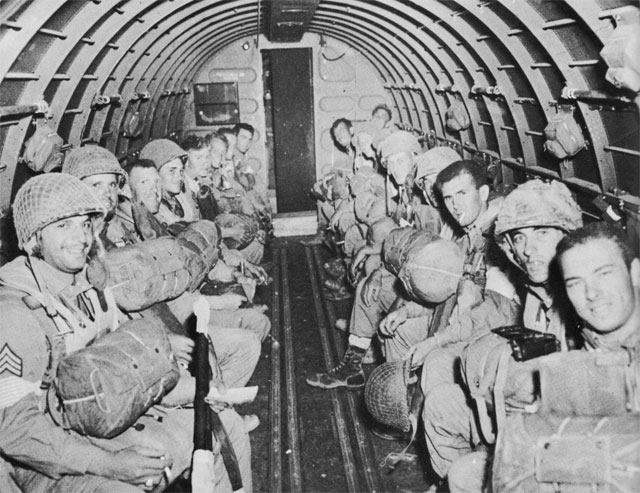
Operation Husky kicked off on July 10, 1943, marking a significant moment in World War II with over 3,000 ships and 150,000 troops launching the largest amphibious assault of the war. In the Allied invasion of Sicily, coordination between air and naval forces surprised Axis defenses. Although airborne landings initially faced difficulties due to strong winds scattering paratroopers, seaborne landings along a 170 km coastline were successful.
By the end of the day, seven assault divisions were ashore, focusing on strategic goals like capturing ports and airfields. This facilitated troop buildup and pressured Axis forces, despite approximately 24,850 Allied casualties. The rapid growth of the U.S. Army Air Forces, which produced nearly 80,000 aircraft by the war’s end, was pivotal in supporting such large-scale operations.
After 38 days of fighting, the campaign concluded with the liberation of Sicily on August 17, 1943.
Leadership Dynamics and Coordination Challenges
Despite the initial success of Operation Husky, the leadership dynamics among Allied commanders in the invasion of Sicily posed significant challenges.
General Dwight D. Eisenhower oversaw the operation, but friction arose between British General Bernard Montgomery and American Lieutenant General George S. Patton. Their differing strategies highlighted coordination challenges.
Montgomery’s British Eighth Army preferred a methodical approach, while Patton’s American Seventh Army favored rapid advances, complicating operational unity. Logistical issues further strained efforts, as strong winds scattered American paratroopers, delaying their integration with seaborne forces.
Despite these obstacles, the Allies achieved strategic objectives, establishing a line from Licata to Catania. Ultimately, Patton and Montgomery’s forces converged on Messina, demonstrating operational unity despite personal rivalries.
Italian Political Developments and Impact
As the Allied forces advanced through Sicily, a seismic shift occurred in the Italian political landscape that would drastically alter the course of the war. The Italian government faced a turning point as the Fascist Grand Council ousted Mussolini on July 25, 1943. Pietro Badoglio stepped in as the new Prime Minister, secretly negotiating an armistice with the Allies.
This armistice, signed on September 3, 1943, and announced on September 8, transformed Italy from an Axis power to a co-belligerent against Germany. In response, Germany launched Operation Axis, leading to the occupation of Italy and the disarmament of its troops.
Meanwhile, Mussolini, rescued by German forces, established the Italian Social Republic in Northern Italy, complicating the Italian political situation in World War II.
Outcomes and Historical Significance
The seismic shifts in Italy’s political landscape during the Allied advance in Sicily set the stage for significant outcomes and lasting historical significance.
Operation Husky’s success led to the liberation of Sicily, capturing over 60,000 Axis troops. This crucial victory weakened the Axis powers, contributing to the downfall of Benito Mussolini on July 25, 1943.
As a result, Italy signed an armistice with the Allies on September 8, 1943, transforming from an Axis power to a co-belligerent against Germany.
Despite approximately 24,850 Allied casualties, the operation showcased the Allies’ strategic effectiveness. The invasion paved the way for the campaign in mainland Italy, accelerating the comprehensive liberation effort in Europe, marking a turning point in World War II history.